

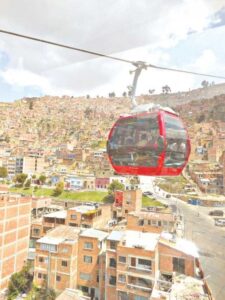
Mi Teleférico is the cable-car public transport system used to move around La Paz and El Alto.
There are 10 different coloured lines. At first the map can look complicated, but the system itself is quite simple once you understand three things:
Which line do I need?
Which direction am I travelling?
Do I need to change lines?
This guide explains the system step by step.
First line: Bs 3
If you continue onto another connected line during the same journey:
Each transfer: Bs 2
So:
1 line → Bs 3
2 lines → Bs 5
3 lines → Bs 7
A change from one line to another is called a transfer — transbordo.
Mi Teleférico has ten lines, each identified by a colour.
🔴 Red — Línea Roja
🟠 Orange — Línea Naranja
🟡 Yellow — Línea Amarilla
⚪ White — Línea Blanca
🩵 Light Blue — Línea Celeste
🔵 Blue — Línea Azul
🟤 Brown — Línea Café
⚙️ Silver — Línea Plateada
🟣 Purple — Línea Morada
🟢 Green — Línea Verde

You do not need to memorise all ten lines.
Before travelling, simply work out:
Where am I starting?
Which station do I want?
Which colour gets me there?
Do I need to transfer?
The normal fare is:
| Journey | Fare |
|---|---|
| First line | Bs 3 |
| Each connected transfer | Bs 2 |
For example:
If you take the Light Blue Line and then change to the Green Line, you pay:
Bs 3 + Bs 2 = Bs 5
Monday–Saturday:
6:30 AM–10:30 PM
Sundays & public holidays:
7:00 AM–9:00 PM
If you plan to use the system very early or close to closing time, it is always sensible to check for temporary changes before travelling.
This is where it is important not to confuse the different options.
For this guide, we are separating them clearly.
If you are visiting La Paz for a short time, the easiest option is simply to buy your journey at a Mi Teleférico station.
Tickets can be bought at the stations whether you are travelling alone or with other people.
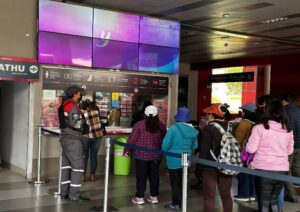

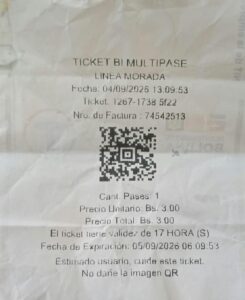
Tell the member of staff where you want to go, especially if you need to use more than one line.
For a simple one-line journey:
If your journey includes a transfer, the connected fare applies.
The Card is a reusable physical card.
This is useful if you expect to use Mi Teleférico repeatedly rather than queuing to buy a ticket for every journey.
Bs 35
Bs 15
After using the included credit, you can recharge the card with additional credit.
No.
You pay the same standard fares as you would with individual journeys.
Its main advantage is convenience.
Yes.
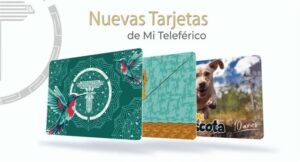
Cards can be purchased at Mi Teleférico stations.
Some busy stations have dedicated yellow booths for sales and recharging like:
Central
Libertador
Obelisco
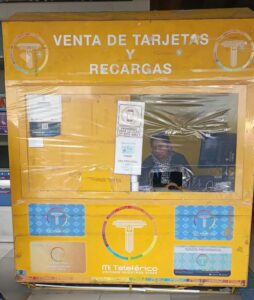
If you’re only going to use Mi Teleférico once or twice:
probably not.
If you’re staying several days and expect to use the system frequently:
it can be much more convenient.
Mi Teleférico also has a virtual-card option.
If you plan to use Mi Teleférico several times, YALA lets you use your phone as a virtual transport card instead of buying a paper ticket for every journey.
The official Mi Teleférico app allows you to check your balance, recharge virtual or registered physical cards, check journey costs and enter the system using your phone.
Search for Yala Mi Teleférico, published by Mi Teleférico.
The app is also available for iPhone.
Open the app and register with your email address.
During activation, the app may ask for:
The registration screens may change as the app is updated, so simply follow the instructions shown in YALA.
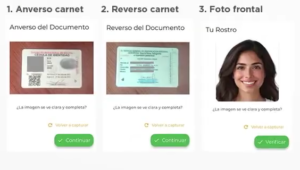
Once your account has been verified, your virtual Mi Teleférico card appears inside the app.
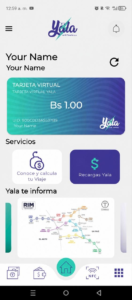
Recent Mi Teleférico information indicates that activation can now be completed directly through the app, without having to visit a ticket office.
From YALA you can recharge your virtual card and registered physical cards.
Online recharge options can include QR payment and other available electronic payment methods. You can also ask station staff about cash recharge options if needed.
When you are ready to travel, open your virtual card in YALA.
Depending on the option available on your phone and in the app, you can enter using:
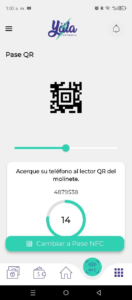
QR
Display the QR pass and scan it at the reader on the turnstile.
NFC
Activate the NFC pass and hold the back of your phone close to the reader.
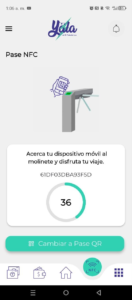
Mi Teleférico currently lists both QR and NFC as ways of accessing the system through YALA.
Your field test also shows both interfaces: a QR pass screen and a separate NFC pass screen.

The app can also help you:
For a traveller taking only one or two cable-car journeys, buying a normal ticket at the station is usually easier.
YALA becomes more useful if you expect to use Mi Teleférico repeatedly during your stay and prefer not to buy a new ticket each time.
Imagine you’re taking the correct coloured line.
That doesn’t automatically mean you’re going in the correct direction.
At stations in the middle of a line, cabins travel in both directions.
Look at the signs above the entrance.
Check the destination shown.
Make sure it is the direction you need.
Don’t only ask:
“Am I taking the Green Line?”
Also ask:
“Which direction on the Green Line?”
If you are using the ticket described in the guide, scan it at the small white scanner at the entrance.
The field instructions specify placing the QR code facing upwards towards the scanner.
Wait for the gate to make a sound.
Then pass through and follow the signs towards the cabin.
Once you’ve chosen the correct direction, follow the signs to the boarding area.
Cabins arrive continuously.
Allow people to leave the cabin first, then enter.
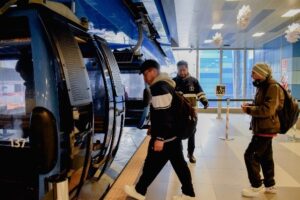
A transfer — transbordo — is when you change from one coloured line to another.
You do this at stations where two or more lines connect.
You normally follow the signs inside the station towards the next line rather than simply going out into the street.
Always check:
the colour
and
the direction
of the next line.
| Station | Connections |
|---|---|
| Villarroel | White + Orange |
| Busch | White + Brown |
| Del Poeta | White + Light Blue |
| Libertador | Light Blue + Yellow + Green |
| Mirador | Yellow + Silver |
| Faro Murillo | Silver + Purple |
| 16 de Julio | Silver + Red + Blue |
| Central | Red + Orange |
You are travelling from Prado towards Irpavi.
🩵 Light Blue Line
↓
Libertador
↓
🟢 Green Line
↓
Irpavi
That change at Libertador is your transfer.
| Line | Approx. time |
|---|---|
| 🔴 Red | 10–12 min |
| 🟡 Yellow | 16–19 min |
| 🟢 Green | 16–18 min |
| 🔵 Blue | 20–23 min |
| 🟠 Orange | 12–14 min |
| ⚪ White | 13–15 min |
| 🩵 Light Blue | 11–12 min |
| 🟣 Purple | 16–18 min |
| 🟤 Brown | 3–4 min |
| ⚙️ Silver | 11–13 min |
These times refer approximately to travelling the full line.
They are useful for planning but should not be treated as exact timetables.
Three lines directly connect La Paz and El Alto:
🔴 Red Line
🟣 Purple Line
🟡 Yellow Line
These connections are particularly useful because travelling between the two cities by road can take longer when traffic is heavy.
But there is an important distinction:
People travelled between both cities long before it existed.
What the system provides is another, often more efficient, way to move between them.
The Red Line is useful for the corridor connecting:
Central → Cementerio → 16 de Julio
At 16 de Julio, you can transfer to:
🔵 Blue
⚙️ Silver
The Purple Line provides another direct connection between La Paz and El Alto.
At Faro Murillo, it connects with:
⚙️ Silver Line.

The Yellow Line also connects La Paz with El Alto.
At Mirador, it connects with:
⚙️ Silver Line.
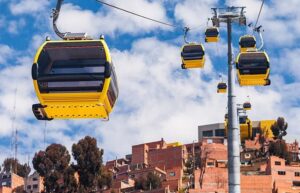
The Blue Line is useful for moving across El Alto and connects with the rest of the network at 16 de Julio.
Morning: 7:00–8:00 AM
Midday: 12:00–1:00 PM
Afternoon: 5:00–6:00 PM
Expect longer queues at busy stations and transfer points.
If your schedule is flexible and you want a quieter journey, travel outside normal commuting periods.
If you’re travelling through 16 de Julio on a Sunday, expect more people because Sunday is one of the main days of Feria 16 de Julio.
This doesn’t mean you shouldn’t use the cable car.
Simply allow more time.
lifts
ramps
facilities for pushchairs
wheelchair access
If you require a specific accessible route inside a large station, ask a member of staff.
16 de Julio
Faro Murillo
Mirador
as particularly good places for views.
But almost every line gives you a different perspective on La Paz or El Alto.
Mi Teleférico is public transport first.
The views are one of the benefits of using it.
Outside many stations you’ll find other forms of transport, including:
🚐 minibuses
🚕 taxis
🚌 other public transport
This is important because the cable car won’t take you directly to every destination.
Sometimes the easiest route is:
Cable car → minibus
or:
Cable car → taxi
For example, our independent route to Valle de la Luna uses the cable car to Irpavi and then continues by road.
Keep valuables secure.
Don’t leave bags or belongings behind.
Ask station staff if you’re unsure about a line or direction.
Don’t run when entering a cabin.
Keep children close when boarding and leaving.
Finding the right coloured line is only half the job.
Check the final destination before scanning your ticket.
If you’re changing lines at a connected station, follow the transfer signs.
Don’t automatically walk out of the station.
It doesn’t.
For some destinations you’ll need to continue by minibus, taxi or on foot.
If you’re sightseeing and have flexibility, travelling outside commuting hours can make the journey much easier.
¿Dónde compro el boleto?
¿Qué línea va a ___?
¿En qué dirección?
¿Dónde hago transbordo a la Línea Verde?
¿Cuánto cuesta el transbordo?
¿Dónde puedo recargar la tarjeta?
Using Mi Teleférico becomes simple if you remember:
Which line?
↓
Which final station?
↓
Do I need to change?
↓
Where do I leave?
That’s all you really need.
Once you understand Mi Teleférico, many places become easier to reach.
If you’re standing in a station and still aren’t sure which direction to take, ask the staff.
We’re building The Alpaca Guide so you can understand how La Paz and El Alto work even when you’re exploring without a guide.
Because seeing a city is easier when you understand how it moves.
 Want to experience La Paz beyond transportation?