

Taking a long-distance bus from La Paz is fairly simple once you understand how the terminal works.
The confusing parts for first-time visitors are usually not the bus itself, but things like:
Which terminal do I need?
Where do I buy my ticket?
What is the extra terminal fee?
Where does my bus actually leave from?
This guide walks you through the whole process.
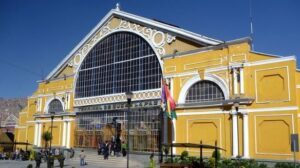
Going to Cochabamba, Oruro, Potosí, Uyuni, Santa Cruz or an international destination?
Use the main La Paz Bus Terminal.
That’s the basic process.
La Paz has more than one departure point for long-distance transport.
This guide is for the:
Use this terminal for destinations including:
Cochabamba
Oruro
Potosí
Uyuni
Santa Cruz
and international routes such as:
Peru
Argentina
Chile.
You may need a different terminal.
For Los Yungas, including Coroico and Chulumani, and for some northern routes such as Rurrenabaque, use Terminal Minasa in Villa Fátima.
rather than the main interdepartmental terminal.
Before taking a taxi to “the bus terminal”, tell the driver which terminal you need.
The terminal is located at:
https://share.google/C54JN34TofHRfGA8u

depending on your starting point and traffic.
If you take a normal street taxi, agree on the price before travelling.
Public transport from central La Paz can reach the terminal for approximately:
If you’re not used to La Paz minibuses and micros yet, read our separate guide:
Look for “TERMINAL” on the sign displayed in the windscreen.
You can also reach the area using the Orange Line and walk from either:
or
If it’s your first time using the cable car:
Individual bus-company counters may operate according to their own schedules, so if you need a very early departure, it is sensible to confirm your ticket beforehand.
When you enter, don’t be surprised if you hear people calling out destinations.
For example:
“Cochabamba!”
“Oruro!”
“Uyuni!”
These are workers representing different bus companies.
If you tell them where you’re going, they can explain the next departure and price and direct you to the appropriate ticket counter.
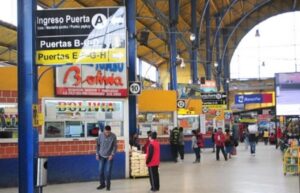
Common routes such as:
Cochabamba
Oruro
Potosí
Longer domestic journeys such as:
Santa Cruz
Uyuni
International routes, including services towards:
Peru
Argentina
Chile
Don’t worry if you can’t immediately find the correct company.
Ask:
¿Dónde venden pasajes para Uyuni?
Where do they sell tickets to Uyuni?
Replace Uyuni with your destination.
At the counter, ask:
¿A qué hora sale el próximo bus a ______?
What time is the next bus to ______?
Then:
¿Cuánto cuesta?
How much does it cost?
And if you’d like to compare:
¿Qué tipo de bus es?
What type of bus is it?
The company will normally assign or allow you to choose a seat.
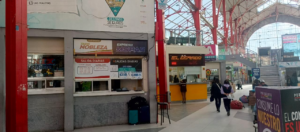
some companies accept cards, but cash remains the safest option to have available.
So don’t arrive assuming every ticket counter will accept your international card.
Bring enough Bolivianos for:
Yes. If you prefer to compare options before going to the terminal, Tickets Bolivia is an online platform where you can search routes, compare transport companies, schedules and prices, and buy tickets in advance.
The platform currently works with more than 60 transport companies and sells both national and international routes.
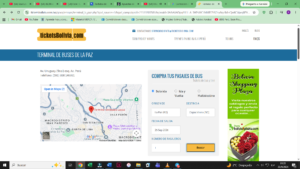
1. Search for your trip
Choose your departure city, destination, travel date and number of passengers.
2. Compare the options
Check the available:
3. Enter your passenger details and pay
You’ll normally need your:
Payment options depend on the booking and payment method available at the time.
4. Receive your booking confirmation
Tickets Bolivia sends your booking confirmation and electronic ticket by email after the purchase is completed.
Even if you book online, don’t arrive at the terminal at the last minute.
Tickets Bolivia states that the electronic ticket may need to be exchanged or checked at the transport company’s counter before boarding. Their current conditions recommend checking in at least:
30 minutes before departure for domestic journeys
and
1 hour before departure for international journeys.
Their current FAQ also asks passengers to bring a printed copy of the e-ticket, together with their ID or passport.
If you booked online, when you arrive at the terminal:
Go to your bus company’s counter first → confirm your booking and departure → exchange or validate your ticket if required → buy the terminal-use ticket → find your puerta and carril.
The Bs 2.50 terminal-use fee is separate from your bus booking.
If your confirmation email does not arrive, check your spam folder and contact Tickets Bolivia before assuming the reservation is confirmed.
This is one of the most important details for first-time travellers.
Buying your bus ticket is not the only payment you need to make.
There is also a separate:
The kiosk is near the main boarding entrances where this ticket is sold.
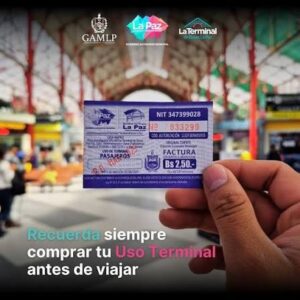
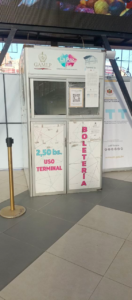
You may need to show or hand it over as part of the boarding process.
Don’t throw it away.
Different companies offer different seat categories.
The exact seats and facilities depend on the company and bus model:
Basic seating with little or limited recline and generally four seats per row.
More suitable for shorter routes.
Destinations such as Oruro as examples.
More comfortable than a normal bus.
Usually includes:
A useful middle option for medium or longer journeys.
The most reclining and spacious category.
Full-recline seating on some services and notes that facilities may include:
depending on the bus model.
For overnight journeys, this is usually the category worth comparing first.
Different bus companies may use similar category names while offering different vehicles.
Before paying, ask:
¿Puedo ver una foto del bus?
or:
¿El asiento se reclina completamente?
If comfort matters to you, ask what the actual bus offers rather than choosing only from the category name.
Prices vary by:
The terminal has an official tarifario — price reference board — which you can use as a guide.
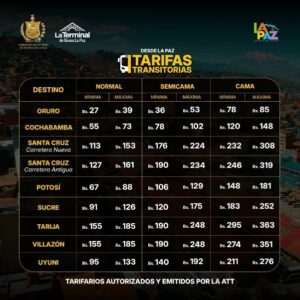
Companies may sometimes offer prices above or below the reference rate.
So if you’re not in a hurry, it can be worth comparing two or three counters.
Once you buy your ticket, look for:
Your boarding gate.
and
The lane where the bus will be waiting.
The company should tell you this information, and it may also appear on your travel receipt.
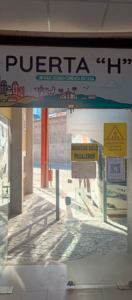
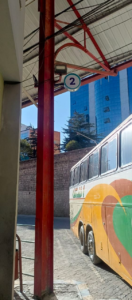
Don’t wait until five minutes before departure to find your gate.
Walk over and identify it first.
Then, if you have time, buy food or use the toilet.
Keep together:
Company representatives may check seating and the terminal-fee receipt before departure.
For international travel, carry your passport.
Large bags normally travel in the bus luggage compartment rather than beside your seat.
Because luggage procedures can vary by company, ask:
¿Dónde dejo mi mochila grande?
or:
¿Dónde dejo mi maleta?
Before handing over a large bag:
Several useful services are available inside the terminal.
Several luggage-storage booths are available, mainly towards the back of the terminal.
Approximately from:
Bs 3 per hour for a small/single bag
up to around:
Bs 25 per day for larger luggage.
Prices can depend on size and storage time.
for toilet use.
There are also shower facilities.
depending on the service/amenities.
This can be useful if you arrive from an overnight bus and can’t check into your accommodation yet.
The second floor has small:
around the middle section of the first floor.
You don’t necessarily need to sit beside the boarding gate with all your luggage.
You can:
Just keep valuables and documents with you.
A practical approach is to arrive with enough time to:
buy/confirm your ticket → pay the terminal fee → find your gate → deal with luggage → board without rushing.
If you are travelling internationally or during a particularly busy period, give yourself additional time.
The terminal has a Defensoría de la Niñez office towards the back of the building, and additional travel authorisation can be required for minors.
The exact requirement depends on the child’s circumstances and who they are travelling with.
If travelling with a minor, check the current documentation requirements before the day of travel.
This is worth understanding when travelling by road in Bolivia.
Prices and operations can be affected by:
If there are major disruptions, ask your bus company directly whether:
the road is open
and
the bus is definitely departing.
Do not assume that having a ticket automatically means the road conditions are normal.
The terminal as generally safe, while recommending the same precautions you would use in any busy transport hub.
Keep:
secure and close to you.
Don’t leave luggage unattended.
Busy places make it easier to become distracted.
Use the official terminal taxi service located directly outside the main entrance.

If using another taxi, confirm the destination and fare before travelling.
You can also check ride apps if you prefer.
Save or screenshot these.
¿Dónde venden pasajes para Uyuni?
¿A qué hora sale el próximo bus?
¿Cuánto cuesta el pasaje?
¿Es semi-cama o leito?
¿Puedo elegir mi asiento?
¿Qué puerta es?
¿Qué carril es?
¿Dónde pago el derecho de uso de terminal?
¿Dónde está la custodia?
¿Dónde dejo mi maleta?
Main terminal and Minasa serve different routes.
Check before leaving your accommodation.
Your bus ticket does not replace the terminal-use ticket.
Buy it before boarding.
Keep it with your bus ticket until you’ve boarded.
If you’re travelling overnight, compare the seat category and actual bus, not just which one leaves first.
Bring cash.
Find the gate and lane early.
Keep valuables with you inside the bus.
Using La Paz Bus Terminal is basically:
Make sure you’re at the correct terminal.
↓
Choose company, departure and seat.
↓
Buy your Bs 2.50 ticket.
↓
Find your boarding point.
↓
Hand over large bags and keep valuables with you.
↓
Keep ticket, fee receipt and ID ready.
That’s it.